
Falls County Sex Offender Checks
The authoritative starting point is the Texas Public Sex Offender Registry, managed by the Texas Department of Public Safety Crime Records Division. It covers public registration records statewide, so a Falls County search can include addresses in Marlin, Rosebud, Lott, and rural areas. DPS officially describes name, area, and institution-of-higher-education search modes. Its materials also refer to SID, address, and map functions. The live options can change, so use the labels shown on the registry instead of assuming that every filter is always present.
Start with geography when the goal is awareness around a home, school route, park, or family address. A name search is useful when the spelling and identity are already known. In either case, compare several public identifiers. Shared names and old addresses can lead to a wrong match. The profile’s photograph, physical description, offense facts, and verification information provide the context needed to distinguish one record from another.
Falls County Area Searches
An area search answers a different question from a name search. It starts with a place and returns registry records tied to that area. Enter the most precise Falls County location the interface accepts, then confirm that each result actually falls within the intended Falls County city or county boundary. Rural Falls County postal addresses do not always align neatly with municipal limits, which matters because the registering authority may differ.
The official DPS registry screen shows the public’s state search entry point.
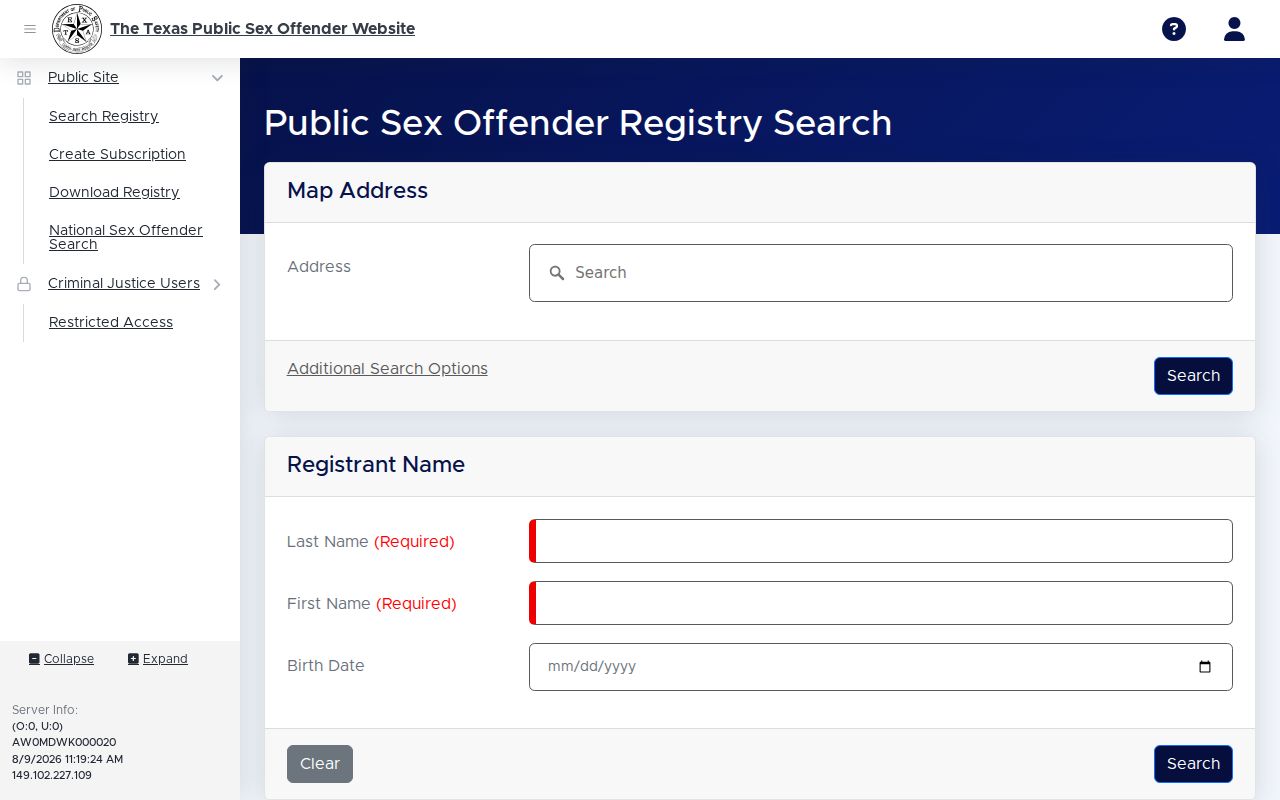
This interface is the direct Texas source for checking current public fields and the date attached to a Falls County registry profile. If the map or radius choices differ from an older description, follow the live DPS controls.
Note: County and city labels help narrow results, but a displayed address and registering authority should still be checked on the full profile.
Texas Public Sex Offender Registry Searches
A disciplined Falls County registry search uses a short sequence. The goal is not just to produce a list. It is to reach the correct official profile, inspect the update information, and avoid confusing a similar name with the person sought.
- Open the Texas DPS public registry and review its current conditions of use.
- Choose a name, area, or other search mode shown by DPS, then enter only the known facts.
- Review the results and compare the photograph, aliases, physical description, and Falls County address.
- Open the full profile and read the offense, registration, risk, and verification fields in context.
The inspected DPS materials support these search routes without establishing that each field is mandatory. The live interface controls the exact input rules.
| Search route | Input type | Required | Use |
|---|---|---|---|
| Name | Text | Set by live form | Find a known person and possible aliases |
| Area or address | Location | Set by live form | Review records near a Falls County place |
| Institution | School search | Set by live form | Use the higher-education mode DPS provides |
| SID | Identifier | Set by live form | Narrow a record when the state ID is known |
| Map | Geographic view | Set by live form | Inspect location-based results visually |
Registry Profiles: What They Show
A Falls County registry profile combines identity details with the legal basis and status of registration. Texas Code of Criminal Procedure Articles 62.005 and 62.051 support the public field set. Some data is kept from public view. Social Security and driver’s-license numbers, phone numbers, online identifiers, employer contact data, victim identity, and other fields designated confidential do not belong in the public profile. A court may also order juvenile registration nonpublic.
| Name and aliases | The registered name plus known aliases used to check identity. |
|---|---|
| Photo and description | A recent color photograph and listed sex, race, height, weight, hair, and eyes. |
| Residence | A street address or detailed geographic description when the statute permits display. |
| Offense | The qualifying offense, conviction date, punishment, and victim age category without victim identity. |
| Risk and status | A numeric Texas risk level plus registration and verification information. |
| Other public fields | School information where applicable and designated vehicle details such as make, model, year, color, VIN, and plate. |
The Texas expunction chapter captured in the manifest is a separate records law, not the source of sex-offender registration duties.
That distinction keeps an expunction source from being mistaken for Chapter 62, the registration program governing the profile fields described here.
Falls County Registry Listings
Registry inclusion means that Texas law requires registration based on a qualifying offense and court history. It does not state that the person is now in jail, on probation, wanted, or accused of a new crime. Custody and warrant status come from other official systems. Treating the registry as a current wanted list can turn a valid public-safety search into a false claim.
If a Falls County profile appears stale, note the registering authority and the verification information. Give that office the Falls County record details needed to identify the profile. Do not confront the listed person or household. The authority can determine whether the public entry reflects a reporting lag, an address update in process, or possible noncompliance.
Registration Levels and Duties in Texas
Texas uses numeric risk levels, but they are not federal tiers. Level 1 describes low danger and a person not considered likely to offend again. Level 2 indicates moderate danger and possible continued offending. Level 3 denotes serious danger and a person considered likely to continue. Civil commitment is a separate court designation for a sexually violent predator. The risk number does not set how long registration lasts.
| Category | Meaning or duration | Verification |
|---|---|---|
| Level 1 | Low danger; duration still depends on offense and history | Usually annual |
| Level 2 | Moderate danger; duration still depends on offense and history | Usually annual |
| Level 3 | Serious danger; duration still depends on offense and history | Usually annual |
| Two or more sexually violent matters | Lifetime or ten-year duty is set by law, not this row | Every 90 days |
| Civil commitment outside a facility | Separate court designation | Every 30 days |
Adult registration lasts for life or for ten years after the latest of release, supervision discharge, or dismissal or discharge, depending on the offense and statute. Juvenile registration is generally ten years after the later of disposition or completion, with special timing for transferred cases. Article 62.101 controls duration. A Falls County reader should not infer a ten-year or lifetime term from the risk label alone.
Falls County Registry Address Changes
Texas address rules generally require in-person notice by the seventh day before a move and again by the seventh day after arrival in the new Texas jurisdiction. The two steps serve different authorities. The first alerts the current registering office; the second establishes the record with the new jurisdiction. A move between rural Falls County and a city can therefore change which local agency handles verification.
Public users should read the update and verification dates as part of the whole profile. A date alone does not prove that someone failed to comply. Report an apparent issue to the listed registering authority and allow that office to check its nonpublic records.
Note: Address duties are imposed on registrants; members of the public should report concerns to police or the sheriff instead of attempting enforcement.
Falls County National Registry Search
The Dru Sjodin National Sex Offender Public Website provides a federated search across participating jurisdictions. It is useful when a name or safety concern crosses state lines. For a Texas record, DPS remains the authoritative state-profile source, so open or confirm the Texas entry after finding a possible match through the national layer.
The national search interface shows why this second layer is broader than a Falls County-only lookup.
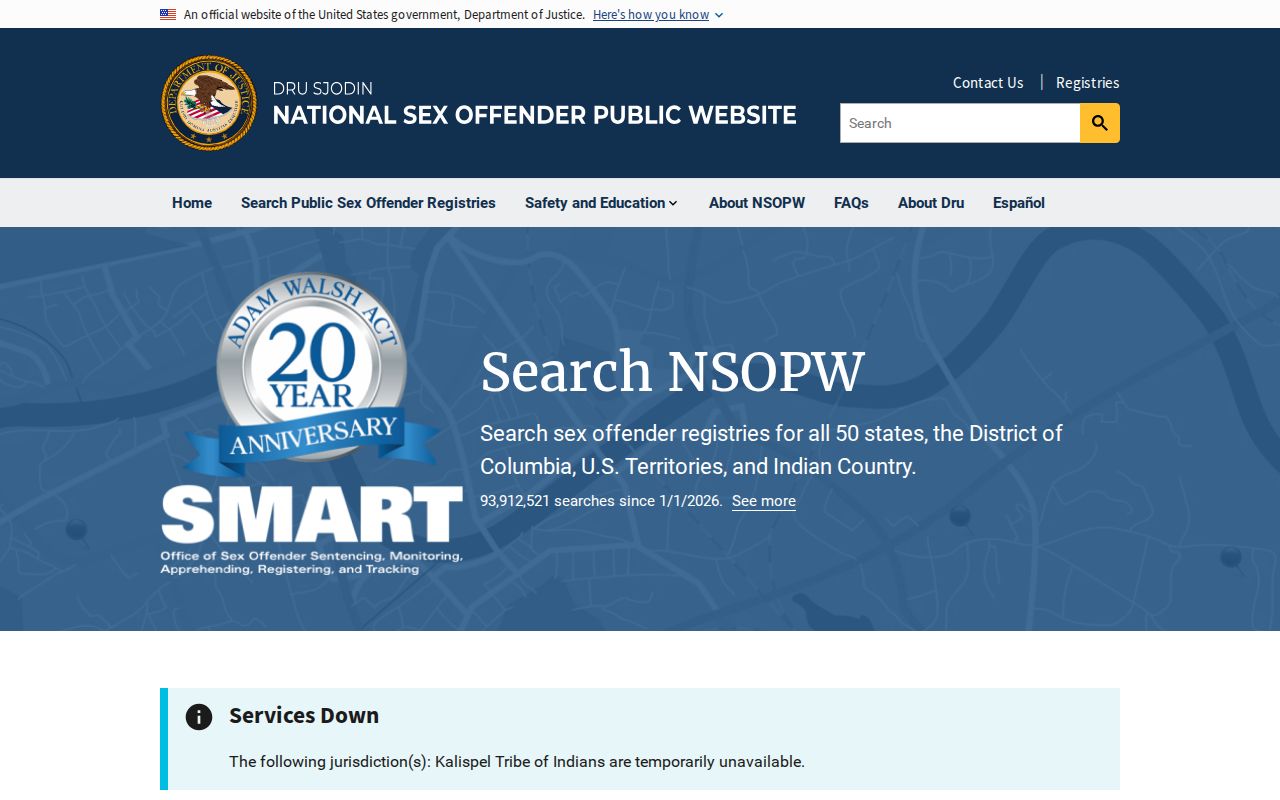
NSOPW can extend the search beyond Texas, while the linked DPS profile supplies the state details used to verify a Falls County result.
Using Registry Information Lawfully
The registry supports personal, family, and community awareness. High-risk and civil-commitment notification may also involve DPS bilingual postcards and school or community channels. Public access does not authorize threats, stalking, harassment, vigilantism, or misuse of protected information. Verify the official record, use it for sound safety planning, and send suspected violations to the appropriate law-enforcement agency.
Code of Criminal Procedure Chapter 62 establishes Texas registration duties. It does not create a special crime for a member of the public who misuses registry data, and Article 62.102 addresses a registrant’s failure to comply. Other Texas criminal laws can still punish threats, stalking, harassment, and related conduct.
Use registry data safely: Threatening, stalking, or harassing a registrant or household can violate general Texas criminal laws. Chapter 62 is not a license for retaliation, and Article 62.102 must not be cited as a public-misuse offense.